iMessage x Pi Durable
A minimal and self-managing iMessage bot — powered by pi durable
众所周知,大陆可用的 IM 有限,除了微信,最为广泛的可能就是苹果的 iMessage 了,也是与 CC 聊天沟通最多的地方。所以开发了 pi-imessage 以便在 iMessage 简单与 LLM 对话。每次我们冷战,便会在家庭群聊中让 Fable 判定谁对谁错。幸运的是,在主动沟通下,倒也总能冰释前嫌,维系这段婚姻。
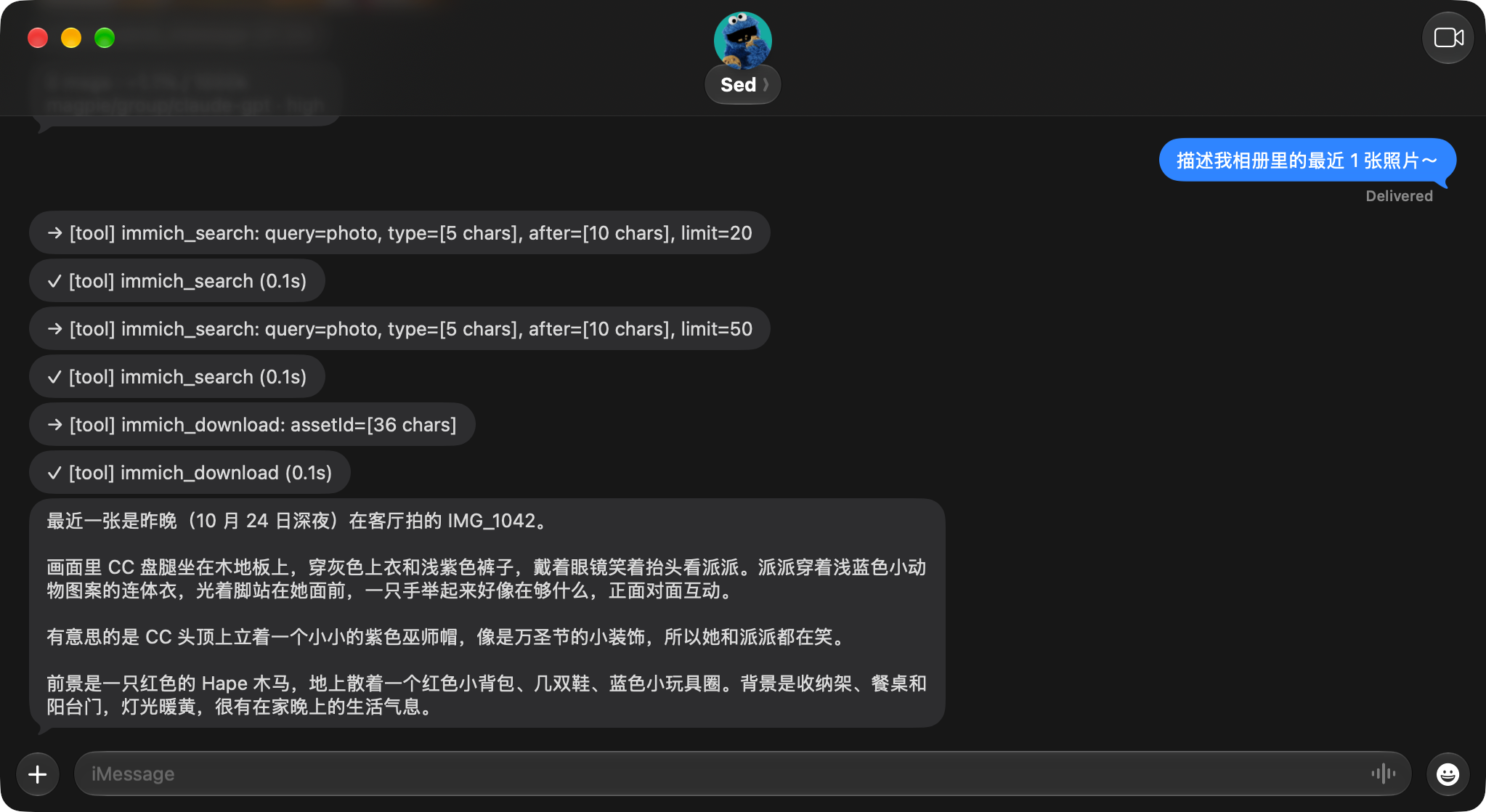
最近将 pi-imessage 从 pi coding agent sdk 迁移至 pi durable,并为其打造了一个可视化的 web ui,以便观察完整内部运行情况。这篇文章将尝试通过一个例子,将 pi durable 的一次请求描述清楚:
Session
A Session owns one mutation line, conversations, entries, tasks, submissions, and documents.
1)Conversations
A conversation is a transcript scope. It may fork another conversation.
一条对话线,可任意 fork 一个分支。例如在 Slack 中,一条 thread 对应 fork 出的一个分支。
In Pi Durable, a subagent is an ordinary conversation owned by the tool task that created it.
虽然在 iMessage 中没有 thread 的概念,但一个对话中,可随时创建一个子对话(非常自然的一个 subagent tool)。
案例群聊对应的 conversation 只保存了一个 id。它既不是从别的对话 fork 出来的(没有 parent),也不属于某个 task(没有 owner),是一个 root conversation:
{
  "id": 29759
}

// 数据结构
type ConversationRecord = {
  id: ConversationId;
  parent?: { conversationId; at: EntryId };
  owner?:  { conversationId; taskId };
};
P.S. 一个 Session 可以同时持有多个 root conversation。pi-imessage 中每个 iMessage chat 各占一个,群聊和私聊彼此平级,都直接挂在同一个 Session 下。
2)Entries
Entry: one immutable transcript record, such as a user message (pi.user), a model response (pi.assistant), a tool result (pi.tool-result), a system prompt change (pi.system), a reset (pi.reset), or your own kind.
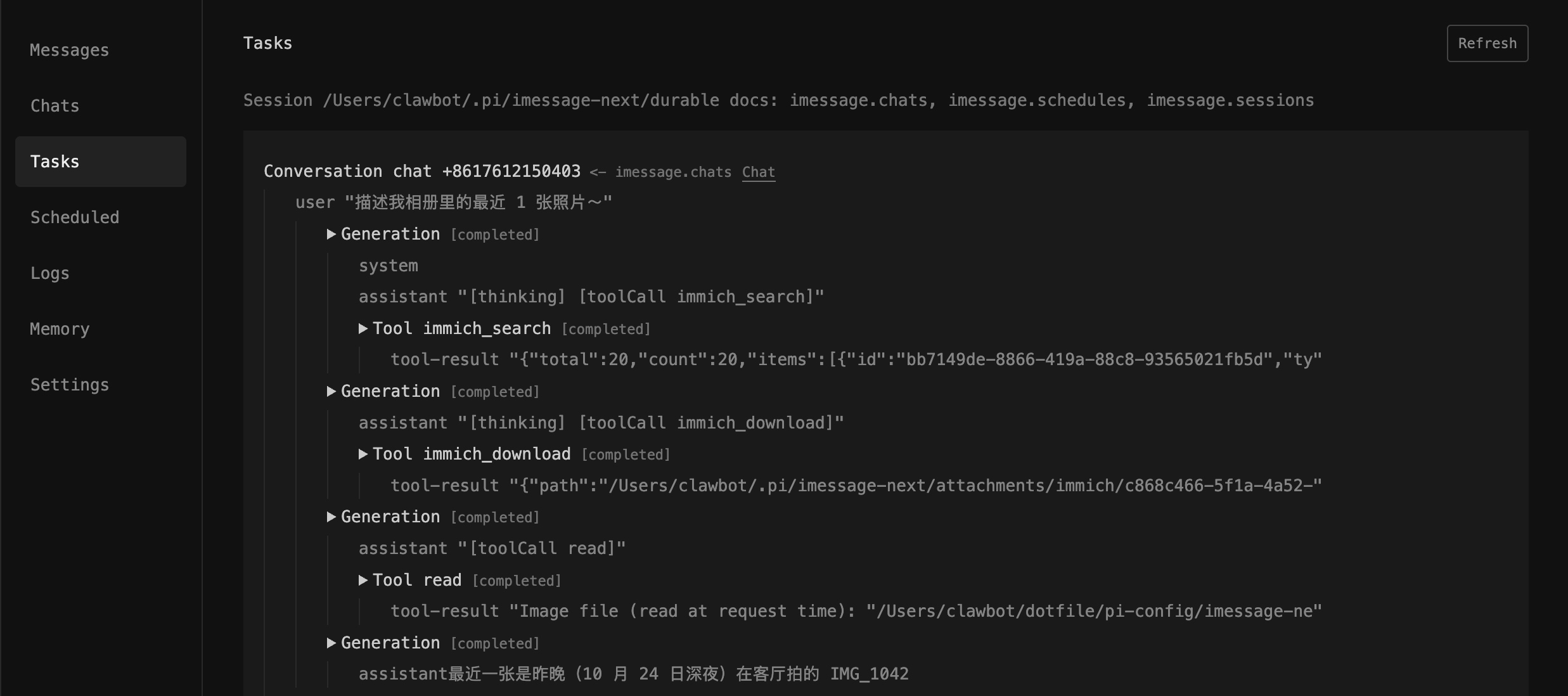
一轮对话创建了四类 entry:用户消息(pi.user),system prompt(仅在变化时写入),每轮模型回复(pi.assistant,包含 thinking 和 toolCall)、每次工具结果(pi.tool-result)。
例如我在群里发的那条消息。其中 model 字段是模型实际看到的内容,kind 标记这条记录的类型。
{
  "model": [
    {
      "role": "user",
      "content": "[Group 'pi admin' from +8617612150403] 描述我相册里的最近 1 张照片~",
      "timestamp": 1792936109669
    }
  ],
  "kind": "pi.user",
  "id": 188017,
  "conversationId": 29759
}
3)Tasks
A task is a durable state machine attached to one conversation.
在 durable 中,模型请求(Generation),工具调用,甚至上下文压缩等,都是 task,而每个 task 维护着各自的状态机(进程崩溃后从 phase 继续)。
内置的 Generation 任务分为以下 phases:
- prepare:准备 system prompt,如果有变化则记录写入 entry。
- request:流式调用模型。
- tools:所有 tool 调用结束后,触发新一轮的 generation。
内置的 Tool 任务分为以下 phases:
- call:正常路径。
- execute:只有崩溃恢复才会进入,根据 replay 参数决定是否重试(safe vs unsafe)。
案例中第一次 immich_search 的 tool task 记录:
{
  "id": 188024,
  "conversationId": 29759,
  "kind": "pi.tool",
  "version": 2,
  "input": { "kind": "model", "assistant": 188023, "callId": "toolu_01DH3ZFiCEhYnszUvNoKECCj" },
  "owner": 188019,
  "background": false,
  "abortRequested": false,
  "state": {
    "status": "terminal",
    "outcome": { "status": "completed", "result": { "kind": "model", "entryId": 188025 } }
  },
  "startedAt": 1792936120316,
  "endedAt": 1792936120395
}
用户的一次输入 prompt 是如何触发 generation?
- pi-imessage 轮训 iMessage chat.db 提交新消息至 Conversation
- pi durable 提交 Submission
- 创建 entry (pi.user)
- 提交 Task (Generation)
- pi durable 通过 Scheduler 消费 Task
const message = { type: "input", content, requestId: guid, whenBusy: "steer" } as const;
return conversation.submit(message, BACKGROUND_CONTEXT);
Tool task 是如何被触发的?
模型自己决定要不要 thinking、要不要调工具(stopReason === "toolUse")。
Tool task 结束后,如何触发下一个 tool task?
tool call 是一次 generation,模型一次性给出的,默认并行执行。
每次新一轮的 generation 是如何最终停止?
第一轮 generation 的 tools 执行完毕后,第二轮 generation 的结果如果 stopReason: stop,则不发起第三轮 generation。
generation#1 调 LLM
← assistant: [toolCall A, toolCall B]  stopReason: toolUse
   ├─ 跑 A
   └─ 跑 B

generation#2 调 LLM,messages 带上 A、B 的结果
← assistant: "完成了"  stopReason: stop
4)Submissions
Submission: something you hand to a conversation, either user input or an entry to write, which you can wait for.
Submission 是把一条输入交给 conversation 后拿到的回执。它本身也是一条持久化记录,状态只会单向推进:queued(会话忙,先排队)-> placed(已写入 user entry,generation 开始)-> done(最终回答落盘)。个人理解方便客户端做幂等与回复。
以案例中我发的那条群聊消息为例。pi-imessage 轮询 chat.db 发现新消息后,用 iMessage 消息的 GUID 作为 requestId 提交:
const message = { type: "input", content, requestId: guid, whenBusy: "steer" } as const;
const submission = await conversation.submit(message, BACKGROUND_CONTEXT);
// submit() 在落盘后即返回,此时回执是 placed,user entry 已写入
// {
//   "id": 188018,
//   "conversationId": 29759,
//   "requestId": "52A7D09E-3AEC-48D3-8428-63957C26EF9F",
//   "type": "input",
//   "status": "placed",
//   "entry": 188017
// }

const settled = await submission.wait();
// 四轮 generation 结束后,answer 指向最终回答的 entry
// {
//   ...,
//   "status": "done",
//   "entry": 188017,
//   "answer": 188037
// }
5)Documents
A document is mutable JSON state represented by Chord operations and occasional complete bases.
Entry 不可变,但有些状态天然要反复修改,这类状态放在 document 里。例如维护了 iMessage chat.db 已经读到哪一行,chatGuid 对应哪个 conversationId 等全局信息。
总结
A Session owns one mutation line, conversations, entries, tasks, submissions, and documents.
至此,对 Session 中管理的五个概念有了最基础的理解,希望你也有所收获~
Conversation 36522(私聊)
│
├─ Submission 184709  placed
│
├─ Entry 184708  user   "描述我相册里的最近 1 张照片~"
├─ Entry 184711  system // prompt 更新
│
├─ Task gen#1 → Entry assistant(immich_search)   → Task tool → Entry tool-result
├─ Task gen#2 → Entry assistant(immich_download) → Task tool → Entry tool-result
├─ Task gen#3 → Entry assistant(read)            → Task tool → Entry tool-result
├─ Task gen#4 → Entry 184734 assistant(text, stop)
│
├─ Submission 184709  done, answer = 184734
│
└─ Document  pi.usage(token 消耗)每轮更新
THE END
突然发现,相比于与全能的 AI 对话,更快理解问题的手段,竟然是直接阅读 项目的 README 文档。